This month I celebrated another birthday and with a birthday in January, I often take a reflective look on my life. I combine New Year resolutions with another year on earth and see how my life is affecting the world I live in.
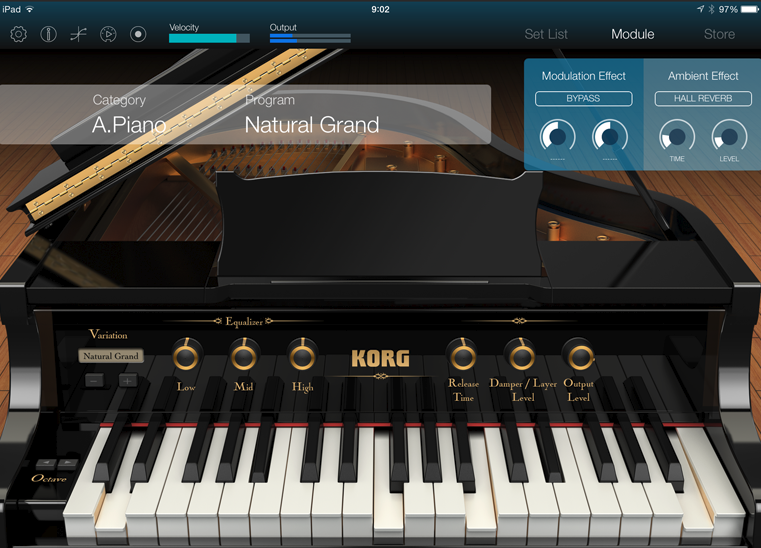
Loving music as I do, I also try to be ethical and cause no harm to the world other than aural abuse (I suffer for my music so its only fair that my listeners have their turn!). Very recently I downloaded Korg Module and the Synthology Ivory piano add-ons without really thinking of the implications. Spoiler alert - the Synthology Ivory pianos sound incredible but that is not what has me soul searching and this is not to be a review nor an endorsement - far from it my friends!
Giving it a little thought, I looked into the Synthology pianos. These are virtual pianos, of course with rich sampling and sounds. These can be played by external keyboards but also via virtual keys which are pretty small in Module. It stands to reason, that these small virtual keyboards are made of virtual ivory! I realize most of you probably knew that being the astute musicians that you are, but to me this was a revelation.
Taking my thought processes further, it stands to reason that virtual ivory must come from virtual tusks which in turn come from virtual elephants! In all my web browsing and computer usage, I don't recall seeing more than a very few virtual elephants. "Why might this be?", I asked myself and came to the same conclusion that you no doubt have also reached - they are nearly extinct!
In fact, now that I think of it, I have read of domain poaching related to the internet and this is probably where the virtual ivory comes from. I think I'm going to have to either come to terms with the ethical implications of using Module or delete it from my iPad.
In all honesty, I have been accused of tree-huggery in my past. I have had my shares of embarrassments. My Nauga preserve in the 1980s went nowhere. Likewise my clay pigeon preserve. Added to the list, my attempt to revive the North American Faux (they are extremely popular for their fur and for leather, a peculiar animal that makes no noise - what does the faux say?) and don't even ask about my mule-breeding experiment.
In any event, I may have to avoid Synthology despite the sound quality or compromise my personal code of ethics. Thanks for reading.
Meanderings about amateur music creation on iMac and iPad using Logic, Garageband or any number of software synths for the iPad
Showing posts with label Korg. Show all posts
Sunday, January 25, 2015
Saturday, January 3, 2015
Twiddling the littleBits Korg
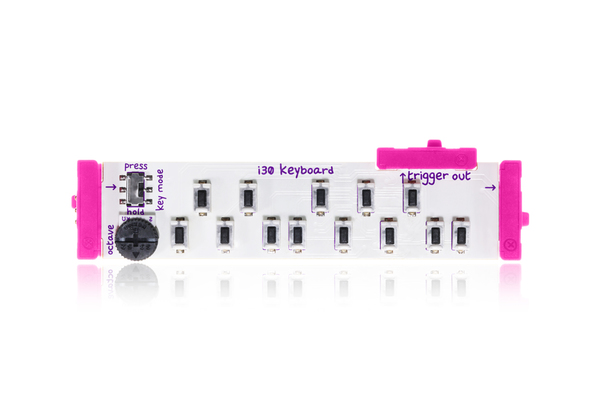
Since my first playing around with the littleBits, I've got the arduino configured so I can use my Akai MPK mini keyboard to control the littleBits synth. Hardware synths are new to me and one challenge is tuning the oscillators! They do have some drift and interesting interactions together. The MIDI program for the arduino has built into it some nice features to mimic an LFO by modulating the pitch with CC1 events and it supports portamento as well as pitch bending. This is much better than using the provided "mini keyboard" which basically is an array of switches:
With the arduino setup, I also can use my iPad to control pitches with any of its MIDI apps which I'll be doing more of as I go on. The piece above was with just the MPK mini on 2 tracks - one bass looped and the other sort a distorted guitar. The distortion interestingly enough was all from the modules in the little bits - no post processing bit crushers or digital noise added. The synth setup for this piece, I call a "mess-20" since it is sort of the MS-20 Korg configuration. 2 analog oscillators, an envelope into the filter that is triggered by note-ons and a simple delay module.
The post processing was limited to some EQ, compression and a stereo-spread module to give the mono synth some sense of space.
So after a few more days of tweaking, I still thing this is an incredible modular setup for very little money! I did add some modules to the bass Synth kit - specifically some wires, mixers, splitters and an additional envelope and oscillator. It is important to remember that these are Korg modules and it IS a mono synth, so no polyphony or stereo in the hardware itself is supported. Likewise, these modules are not inherently velocity sensitive, so any volume adjustments are limited to playing with the volume know (or much easier) done with automation on the track post recording.
I usually record the audio into Logic and there I can add space with the stereo spreader or manipulate the recorded audio in any other ways. I'm sure this is old news to you audio gurus but for a MIDI guy like me, there is a learning curve here. It took me awhile to get the levels right for recording and as of now I am still going through the iMac mic-in port which probably is not the cleanest.
For patch preset saving I resort to the camera on my phone so I can remember the convoluted lego-like layouts of my synth modules for future use :).
Tuesday, December 30, 2014
Modular Synthesizer at last!
My earliest synth memory was seeing a film featuring Wendy (then Walter) Carlos and Bob Moog operating the modular Moog synth in the 1960s (old blog post about it here). For just a few decades, any idea of owning or playing my own synth remained a pipe-dream.
Years later, I got into music making and synthesis via Computer and "virtual synthesizers" and have until recently only ever used software synthesizers. I haven't bought any self-contained synths or other hardware but have collected countless software modules on my desktop (iMac) and more recently on the iPad.
My interests in modular synthesis stayed and I purchased the excellent movie - I Dream of Wires when it came out. Modern modular equipment is a pricey proposition and requires a great deal of assembly and electronic knowledge. Eurorack systems are popular and I've always toyed with the idea of getting into them but these too are costly and laborious to configure and change. Many of my more interesting software synths emulate modular systems such as the Arturia Modular V, iVCS3 and more low-level options such as Reaktor and Adulus.
One reason I tend to prefer the software options is that it is so fast to prototype, mock-up and change any music making ideas I have without having to resort to screw drivers or soldering irons. Nonetheless, the lure of analog and tinkering has remained.
This Christmas, my wonderful wife (at the advice of my older son) bought me the littleBits Synth kit and suddenly, I have a modular system at my fingertips that I can configure/reconfigure in seconds with its brilliant magnetic connection system and self-contained modules. Korg collaborated with littleBits and produced some excellent oscillators, sequencers, keyboards, filters and envelopes in a very simple, lego-like configuration. This kit is extremely easy to use, is cheap (compared to other modular setups) and quite powerful.
All by itself, the kit provides enough to put together a two oscillator synth with basic envelope, sequencing and filtering. The keyboard isn't going to produce too much with switches for each note, but you can put int basic notes and run through the sequencer to get some synth rhythms. I bought a few extra modules (splitter, mixer, mounting boards and another oscillator) and put together a basic piece in just a few hours of tinkering. I used the filter in its self-oscillating mode to get a sine wave to mix with the simple saw or square that the Korg oscillator provides.
One thing I have to get used to is recording analog audio! Up until now with mostly MIDI synthesizers or my iConnectMIDI2, the input comes through USB cables or via the iConnectMIDI. The analog synth goes into my somewhat noisy microphone jack on my iMac. I might need to consider an audio interface at some point.
Another work in-progress for me is connecting the modular synthesizer into my music-making via MIDI. There is a module "in the works" for MIDI control but some littleBits users have already solved this by using a littleBits Arduino module to plug into the kit. I bought the littleBits arduino and am working on the MIDI integration.
There are a few projects already outlining how to do this here and here. The second link has a much richer MIDI sketch and is probably the one I will adapt. For my needs, I am more interested in a MIDI solution to integrate with external sequencers and MIDI controllers in my studio rather than for live performance. An added bonus is that I get to do some programming as well :).
I've put the arduino beta programming environment onto my iMac and have got the basics working so stay tuned and I'll update my progress as it goes.
Years later, I got into music making and synthesis via Computer and "virtual synthesizers" and have until recently only ever used software synthesizers. I haven't bought any self-contained synths or other hardware but have collected countless software modules on my desktop (iMac) and more recently on the iPad.
My interests in modular synthesis stayed and I purchased the excellent movie - I Dream of Wires when it came out. Modern modular equipment is a pricey proposition and requires a great deal of assembly and electronic knowledge. Eurorack systems are popular and I've always toyed with the idea of getting into them but these too are costly and laborious to configure and change. Many of my more interesting software synths emulate modular systems such as the Arturia Modular V, iVCS3 and more low-level options such as Reaktor and Adulus.
One reason I tend to prefer the software options is that it is so fast to prototype, mock-up and change any music making ideas I have without having to resort to screw drivers or soldering irons. Nonetheless, the lure of analog and tinkering has remained.
This Christmas, my wonderful wife (at the advice of my older son) bought me the littleBits Synth kit and suddenly, I have a modular system at my fingertips that I can configure/reconfigure in seconds with its brilliant magnetic connection system and self-contained modules. Korg collaborated with littleBits and produced some excellent oscillators, sequencers, keyboards, filters and envelopes in a very simple, lego-like configuration. This kit is extremely easy to use, is cheap (compared to other modular setups) and quite powerful.
All by itself, the kit provides enough to put together a two oscillator synth with basic envelope, sequencing and filtering. The keyboard isn't going to produce too much with switches for each note, but you can put int basic notes and run through the sequencer to get some synth rhythms. I bought a few extra modules (splitter, mixer, mounting boards and another oscillator) and put together a basic piece in just a few hours of tinkering. I used the filter in its self-oscillating mode to get a sine wave to mix with the simple saw or square that the Korg oscillator provides.
One thing I have to get used to is recording analog audio! Up until now with mostly MIDI synthesizers or my iConnectMIDI2, the input comes through USB cables or via the iConnectMIDI. The analog synth goes into my somewhat noisy microphone jack on my iMac. I might need to consider an audio interface at some point.
Another work in-progress for me is connecting the modular synthesizer into my music-making via MIDI. There is a module "in the works" for MIDI control but some littleBits users have already solved this by using a littleBits Arduino module to plug into the kit. I bought the littleBits arduino and am working on the MIDI integration.
There are a few projects already outlining how to do this here and here. The second link has a much richer MIDI sketch and is probably the one I will adapt. For my needs, I am more interested in a MIDI solution to integrate with external sequencers and MIDI controllers in my studio rather than for live performance. An added bonus is that I get to do some programming as well :).
I've put the arduino beta programming environment onto my iMac and have got the basics working so stay tuned and I'll update my progress as it goes.
Labels:
Arturia,
Audulus,
I Dream of Wires,
iPad,
iVCS3,
Korg,
littleBits,
modular,
Reaktor,
synth
Subscribe to:
Posts (Atom)